

When intuition surpasses science: GENESIS-AI and the era of complex artificial intelligence systems
- Jan 23
- 4 min read
In the world of technology, it is rare for an engineer's "feelings and beliefs" to surpass a scientist's "microscope and eye." However, the history of the GENESIS-AI project is a record of just such a moment—a moment when an intuitive decision to reject monolithic giants in favor of team intelligence proved prophetic.
Memories from the "technological wilderness"
Let's go back to the conceptual planning phase of the Application Factory as part of the GENESIS-AI project. It was a peculiar time – the market was intoxicated with the possibilities of giant language models (LLMs). Every week brought reports of a new, "bigger and better" model that was supposed to solve all of humanity's problems. At that time, autonomous AI agents (Agentic AI) were whispered about, treated as an academic curiosity. Small language models (SLMs), on the other hand, were pushed to the sidelines, considered poor relatives of their multi-parameter brothers. Despite this ubiquitous fascination with gigantism, the GENESIS-AI team had a different feeling. Guided by engineering intuition, we refused to trivialize the potential inherent in specialization. Instead of betting on a single "omniscient brain," we began to sketch a system resembling a biological structure or a well-organized corporation—a system based on collaboration. The most fascinating thing about this process was that we were moving in a virtually virgin, unexplored technological space. With no hard data and no limits to our imagination, the concept began to take shape – first on paper, then in the system architecture.

GENESIS-AI architecture: Three layers of intelligence
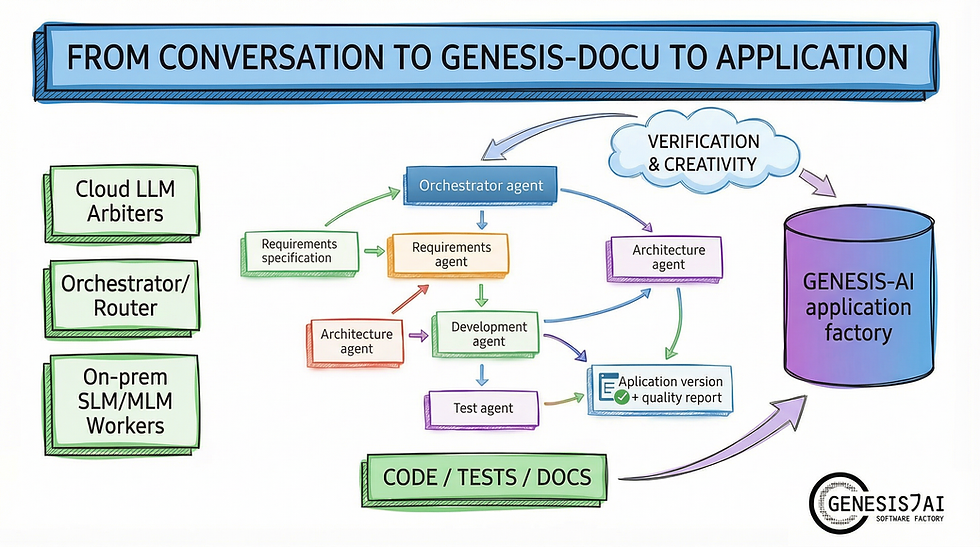
As a result, the GENESIS-AI concept documentation adopted an assumption that may have seemed risky at the time, but is now considered state of the art. The system was designed as a multi-layered structure of specialized AI agents controlling a group of SLM (Small Language Models) and MLM (Medium Language Models).
The developed topology is based on three pillars:
Fundamental Layers (On-Premises): The two lowest layers of language models, maintained in a secure local environment. They are responsible for performing elementary, repetitive, but critical tasks of the software development life cycle (SDLC), such as code generation, unit testing, and technical documentation.
Arbitration Layer (Cloud): The third, external layer, using powerful commercial LLM models. They are not used for "dirty work," but perform arbitrary, verification, and creative functions at the highest level of abstraction.
Intelligent Orchestration: The whole process is supervised by a superior orchestrator agent, which manages the flow of information between the "workers" (SLM) and the "managers" (LLM).
Science confirms intuition: Evidence of correctness
As time passed, it turned out that our intuition had not failed us. What was an "engineering hunch" in GENESIS-AI became the subject of groundbreaking research at the world's leading universities in 2023-2024. Science even coined a term for our approach: Compound AI Systems .
Here are three key pieces of scientific evidence that confirm that the GENESIS-AI architecture is the future, not an experiment.
Evidence 1: Cost-effectiveness and quality (Stanford University)
Researchers at Stanford University, in their "FrugalGPT" project, proved exactly what we assumed in our on-premises layers. They showed that a cascade of smaller, cheaper models, controlled by an intelligent router, can achieve results equal to or better than the most expensive LLM models (such as GPT-4), while reducing costs by up to 98%.
"Our results show that FrugalGPT can match the performance of the best individual LLM models [...] while reducing inference costs by orders of magnitude." — (Chen et al., 2023)
Evidence 2: The advantage of teamwork (Together AI)
In mid-2024, research on the MoA (Mixture-of-Agents) architecture was published. The results were a shock to the industry. It turned out that a "collective" consisting of several open-source models (the class we use in GENESIS-AI) could defeat the giant GPT-4o in a direct confrontation. This is because the models can correct each other's mistakes.
"We found that the collaboration of multiple LLM models allows them to leverage their strengths and overcome the weaknesses of individual units. Our MoA method achieved a score of 65.1% on the AlpacaEval 2.0 benchmark, outperforming GPT-4o." — (Wang et al., 2024)
Evidence 3: Agent Agency (Microsoft Research)
Research on the AutoGen framework has proven that the key to solving complex problems (such as writing entire application modules in GENESIS-AI) is not a "smarter model" but a "better conversation." It has been proven that interaction between agents—e.g., "Programmer" and "Critic"—leads to self-correcting code.
"We demonstrate that multi-agent conversational frameworks enable LLM systems to autonomously solve tasks that previously required human intervention or were unattainable for single models." — (Wu et al., 2023)
BONUS: Comparison of paradigms
Why is GENESIS-AI a better choice? Let's look at comparative data that contrasts the monolithic approach (one large model) with the approach used in our project (orchestrated SLMs).

Summary: From dream to research reality
Today, as the initial work on the GENESIS-AI project is coming to an end, on the one hand, we can be proud that we predicted the future. Our vision of the potential of hybrid architecture built from closely cooperating SLM, MLM, and LLM models controlled by a set of AI agents has been firmly confirmed by facts.
On the other hand, reality and the current state of knowledge put our project in a completely new light. From a very risky venture based on unexplored technologies and innovation bordering on fantasy, GENESIS-AI has become a project firmly rooted in scientific reality. What we planned in an environment of complete ignorance is now defined as a leading trend in artificial intelligence. Our R&D is taking on concrete, real shapes, and technological risk has given way to the certainty that we have chosen the only right direction.


Comments